
Est. 1975 · Stanislaus National Forest, California
About the Kegger Backpack
Fifty years of cold beer, old friends, and one very inconvenient keg.
What is a Kegger Backpack?
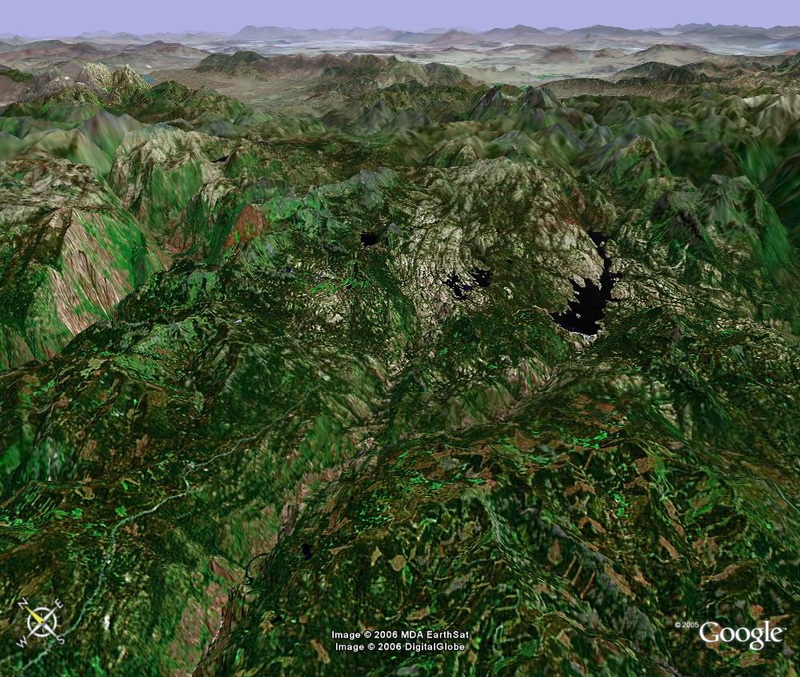
Every year, in the early days of June, a group of friends hauls a full keg of beer several miles into the backcountry of the Stanislaus National Forest in the Sierra Nevada mountains of Northern California. They have been doing this since 1975. The 51st gathering is planned for June 2026.
A standard half-barrel keg — what most people know as "a full keg" — holds 15.5 gallons of beer. The keg alone weighs 30 pounds. Full, it weighs 160 pounds. There is no road. There is no trail the whole way. Moving it requires four to six strong people carrying a stretcher, with additional relievers rotating in, and someone out front scouting the route. This is not a casual undertaking.
The reward is a long weekend in a beautiful, private spot in the High Sierra — campfires, swimming holes, fishing, old friends, new faces, and cold beer cold in the mountains. At its peak, 60 or more people have attended. Some years it's a smaller, more intimate gathering. The first kegs were whatever was cheapest. These days, micro-brew kegs are more the norm.
All U.S. Forestry regulations are strictly enforced. The group takes care of the land.
A little history

As kids, the group of guys that started this thing all joined the Boy Scouts. We were lucky enough to be in a troop that spent summer camp about five miles down the valley from the Kegger Backpack spot. One day while hiking up river, Bucky and I came across the spot we party in today. I remember thinking "this is a great spot and could host a party of 50."
Around six years later, we were a bunch of teenaged alcoholics whose favorite pastime was drinking kegged beer. In 1976, Bucky and I were heading out on a cross-country adventure in my '66 Camaro. Pat Williams and Tom Caton were going to spend the next ten weeks working on the staff at the scout camp. I was trying to figure out what would be an appropriate going-away party for the four of us, and remembered this spot.
The first stretcher was made out of 2×4's at my dad's shop. We had a party of about 15 people. I recall seeing Tom and Pat leaving the party going down river to camp as the rest of us were leaving going up river. The last stop on our cross-country tour was the Boy Scout camp — seven weeks and 9,300 miles later — to visit Tom and Pat on their last week of camp.
The next year, I too was working at the scout camp, along with our friend Mike Kemper. We decided to have the party again at the same spot, and so it began. This was where I met Phil, who had walked from Sonora with John Baird, who had assured Phil there would be food and beer at the end of the trail.
Year three found Kemper and Mike Williams working at the camp, so we did it again. By then, I had the feeling that a tradition was brewing. It was a three-barrel affair.
Around year seven, Phil was bringing along a pretty good team of beer drinkers of his own, and the party grew to around 60 people. Thinking a group this size every year would start taking its toll on the environment, Phil started having his party on a different weekend — so for about three years, there were two Kegger Backpacks.
Twice, we have had to hold the party at an alternate spot. Once we were snowed out and held it 25 miles down the road at a true island on the same river. We went back with a small party in August to the original spot — a one-keg affair. A few years ago, the big New Year's rains washed out the road into the valley, so we held it at the public camp near the Boy Scout camp.
Many of the people you will be partying with this year have been on ten or more of these parties. Several, I have known all my life. I look forward to this reunion with old friends each year, as well as to the opportunity to make new ones.
We aren't quite as wild as we used to be, but still party pretty well.
I am sure you will agree that this campsite is special. It has held up well over the years, and we do our best to leave it as clean as possible each year.
Rules of etiquette — please observe
- No smoking on the trails
- No firearms
- Use the latrine, or go at least 100 feet from the water for waste — bury all waste and TP
- Pack it in, pack it out
- Non-aggressive dogs only
- Fires in existing fire areas only
See you there for some new memories and to create more history.
— Tom McGonigle
The Tequila Break-Out: a prelude
Before the Kegger Backpack became the Kegger Backpack, there were the Tequila Break-Out parties — the TBO. These photos, shared by Bucky in 2010, are believed to be from the second TBO, winter of 1975–1976. They show the crew that would go on to start it all, at the Pico Blanco Boy Scout Reservation, in full pre-party form.
In Pat's words: "I think the Tequila Break-Out parties were part of the quest for that ultimate back-pack party that became the KBP. This is cool!"
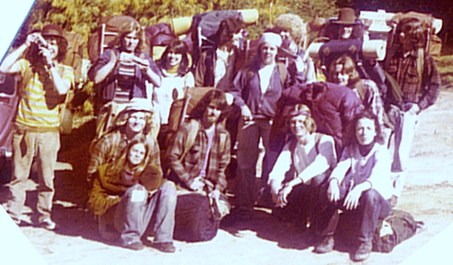
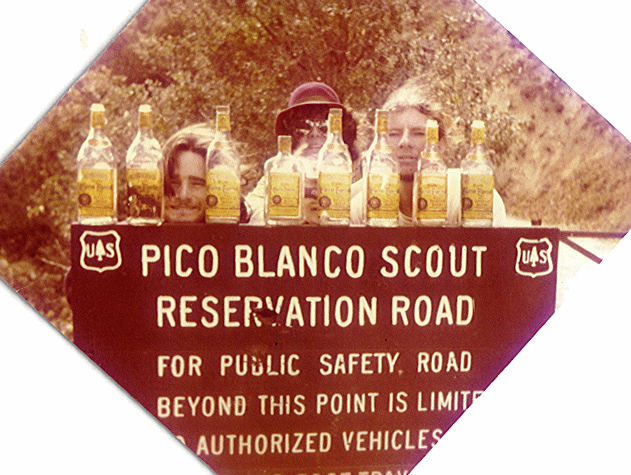

The Kegger Backpack itself began in 1976. The Tequila Break-Out was the warm-up act. The tradition has continued for 51 years and counting.
The Stanislaus National Forest
The Stanislaus National Forest is located east of Sonora in Central California's Gold Rush country, covering 895,500 acres. State Highways 4, 108, and 120 provide access. Established on February 22, 1897, it is among the oldest of the National Forests.
The forest is named for the Stanislaus River, whose headwaters rise within its boundaries. The Spanish explorer Gabriel Moraga named the river "Our Lady of Guadalupe" during an 1806 expedition. It was later renamed in honor of Estanislao, an Indian leader.
The Kegger Backpack spot sits within this forest — a high Sierra location that, according to some accounts, was an ancient Native American summer gathering place. It has been the site of this annual gathering for 50 years.
Moving the keg
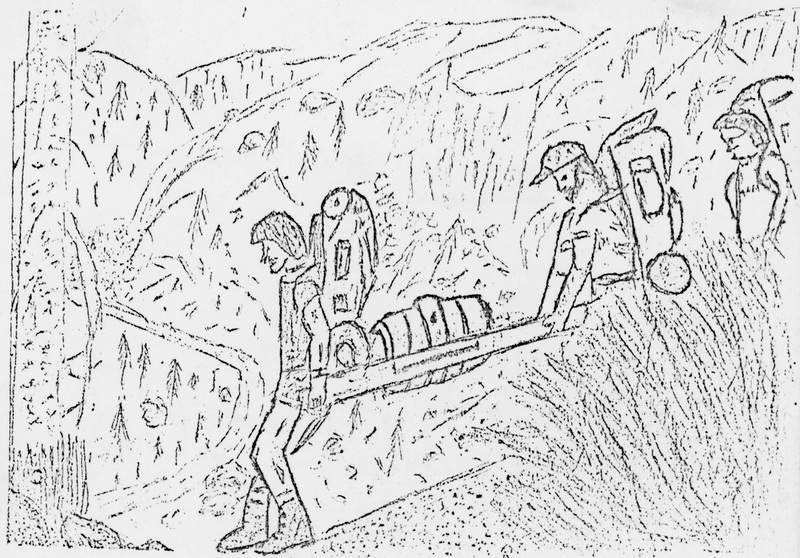
Moving a 160-pound keg several miles on foot, off-trail, through mountain terrain, requires four to six strong carriers plus relievers rotating in. The original stretcher was built from 2×4 lumber. Over the years the design has evolved, but the fundamental challenge — and the bragging rights that come with it — remain the same.
For the full story of the carry, see Stretchers & Kegs in the Chronicle.