
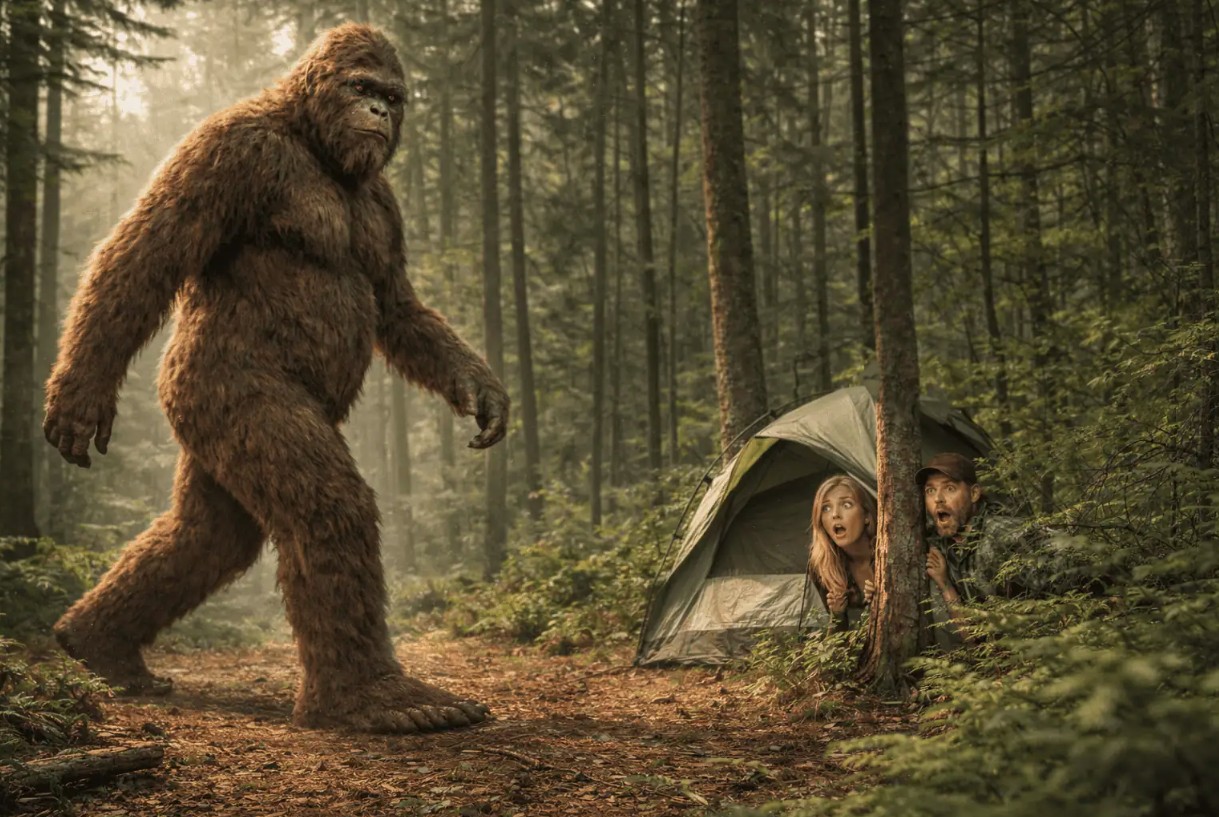
The Kegger Backpack takes place in a remote stretch of the Stanislaus National Forest — deep granite canyon country, far from any town, the kind of place where the forest sounds considerably more alive at 2 a.m. than it does at noon.
So when a former Kegger participant submitted a Bigfoot encounter report to the Bigfoot Field Researchers Organization describing a late-night experience near Spicer Reservoir — roughly three miles from the Kegger campsite, on the same river — it felt less surprising than it might have otherwise.
The report is real. It is on official file with the BFRO. It happened in July 1977, one year after the very first Kegger Backpack. The witness was a new high school graduate, an Eagle Scout and college football recruit, camping in the same canyon we camp in today.
A brief history of Bigfoot in America
1958: The word "Bigfoot" enters popular culture after large, unidentified tracks are found at a construction site in Humboldt County, California.
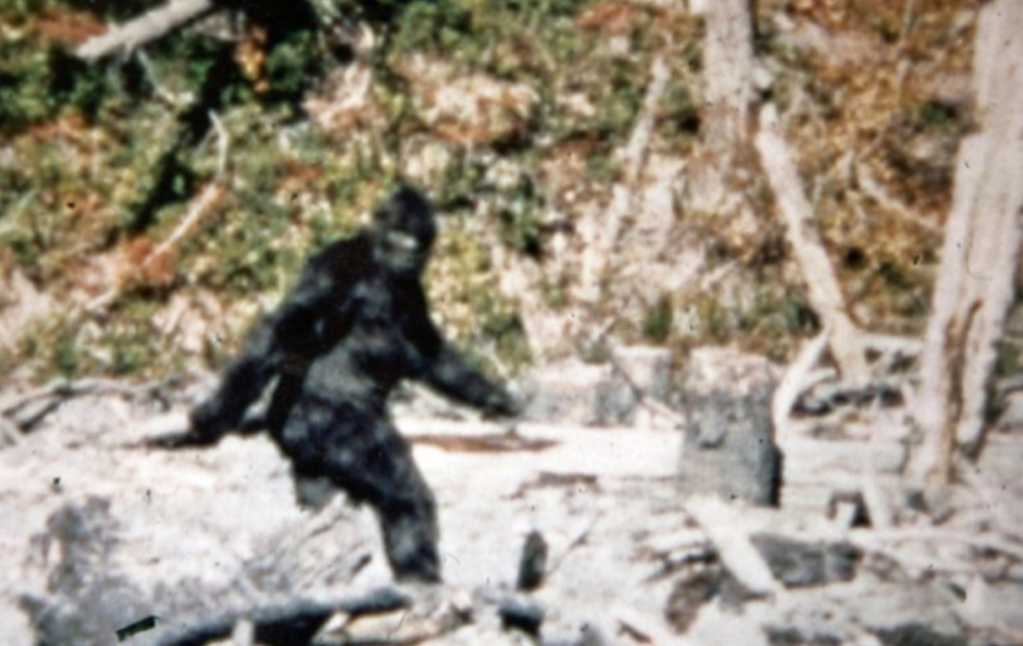
1967: Roger Patterson and Bob Gimlin film a large upright animal walking near Bluff Creek in Northern California. The footage has been analyzed by anthropologists, costume designers, and filmmakers for decades. No one has successfully reproduced a costume matching the subject's proportions or gait. Watch it on YouTube →
1970s–present: Bigfoot becomes a cultural fixture. Researchers apply scientific frameworks. DNA claims, thermal footage, audio recordings, and footprint casts continue to surface. The debate never ends.
What the documented evidence actually shows
Setting aside belief entirely, a few things are simply documented facts:
- For over 400 years, people across North America have reported large, hair-covered, upright animals in remote wilderness — from people with no apparent motive to fabricate.
- Large human-shaped tracks have been found, photographed, and cast in plaster for over 70 years. Some show dermal ridges and mid-tarsal breaks that physical anthropologists find difficult to explain as fakes.
- Eyewitness accounts regularly come from hunters, biologists, and park rangers — people trained to identify wildlife.
- The cultural histories of many Native American and First Nations peoples describe large, non-human "wild people" that closely match modern sighting accounts.
- They call it a cryptid — an animal whose existence is suspected but not scientifically confirmed. The Yeti. Sasquatch. Australia's Yowie. South America's Mapinguary. The Sierras have their own stories.
Does that prove the creature exists? Or does it just confirm that humans across all cultures have always wanted to believe in a large, elusive, hairy neighbor? You decide.
For more: Bigfoot Field Researchers Organization — bfro.net →
BFRO Report #4366 — Near Spicer Reservoir, July 1977
The following is the complete text of BFRO Report #4366, submitted by the witness on May 24, 2002 — twenty-five years after the incident. The original report is at bfro.net/GDB/show_report.asp?id=4366.
As a new high school graduate in 1977, I planned a camping trip to an area near a Boy Scout camp (Wolfboro) I was familiar with, with my new girlfriend. As an Eagle Scout and an athlete (I was recruited to play football at Cal) I wanted to impress my friend who loved the outdoors. The destination was around a dammed watershed called Spicer's Reservoir.
There was a dirt logging road turnoff from Highway 4, between Bear Valley and Angels Camp. We drove down this winding dirt road — some seven to fifteen miles — crossing over a little bridge that crossed a very shallow Stanislaus River (since it was very hot that summer month), until we reached the end of the road at the dam. We packed about a mile down the river that ran out the bottom of the dam.
This was the middle of the week, and I knew from scouting and other trips that very few people were seen in this area. I was setting up camp at a clearing next to the river and my girlfriend was fishing. It was hot, and she had a tangled line while wading. She called up to me that she saw somebody crossing the river above us — some distance away, on the other side — to warn me not to be surprised if they walked past on the trail. Nobody came down the trail and we forgot the incident. An uneventful evening passed.
The next day we decided to break camp. This required us to drive a few miles to the little bridge crossing the Stanislaus River. We parked next to the bridge and found what looked like a fishing trail. We hiked until it was too difficult to continue — lots of little pines close together and bigger and bigger granite boulders. We found a clearing some twenty yards from the river and I pitched the tent next to a dried creek bed. The rear of the tent was a few feet from a slope of huge boulders and small pines.
We made a campfire when evening fell. It was a clear moonlit night except for distant thunder. Later in the evening, when we were about to turn in, we heard strong screams coming from upstream — in the direction where the trail had become impassable. The screams occurred periodically for half to a full hour. I rationalized them as a sick or injured range cow. During my scouting days I had been told that cattle roamed the area.
We went to bed. We must have been asleep only a couple of hours when the thunder woke us. Once back in my sleeping bag I stayed awake listening — and then I heard two footsteps behind us on the rocks of the dried creek bed. Two more steps. A pause. I was scared, especially since Friday the 13th had just been playing. I really thought it was a person stalking us.
I peered out the back mesh window of the tent. What I saw was a large silhouette — standing, then moving two steps at a time — past a tree in that dried creek bed. After what seemed like a long time, the thing moved deliberately past our tent toward the river. Then it started splashing and making that strong high-pitched screaming noise at the river's edge. I heard footsteps come directly toward our tent and stop right in front of it. My hand was on my buck knife. Then I heard it run away.
I think, after a while, we said something like "did you hear that — let's get out of here." Daybreak was not far off and we waited for the first sign of light. We hastily packed up camp and drove home.
We eventually connected the "fisherman" crossing the river below the dam the day before — the one who never came down the trail — to possibly not being human at all. My girlfriend said this person was dressed in very dark clothing, which seemed odd since it was so bloody hot. I haven't changed my story in 25 years.
Why this matters to the Kegger
The same canyon. The same river. The same year the Kegger began.
Spicer Reservoir sits roughly three miles from the Kegger Backpack campsite, upstream on the Middle Fork Stanislaus River. The terrain the witness describes — the logging road off Highway 4, the bridge crossing the shallow Stanislaus, the granite boulders, the fishing trail that runs out — is identical to what Kegger participants navigate today.
The witness mentions Wolfboro Boy Scout Camp by name. Tom McGonigle's history notes that the Kegger group spent summers at Wolfboro — five miles down the valley — and that Tom and Bucky discovered the Kegger spot itself while hiking upriver from Wolfboro. This witness was camping the same canyon, the same summer, one year after the very first Kegger Backpack.
Two screaming incidents. Footsteps in a dry creek bed. A large silhouette moving past the tree line in the dark. Footsteps stopping directly in front of a tent.
Draw your own conclusions. But the next time you are lying in your tent at 2 a.m. listening to the Stanislaus running through the canyon, you may find the question a little more interesting than you expected.
The 1967 film
The Patterson–Gimlin film was shot in Northern California — the same state, the same Sierra terrain, eleven years before the Wolfboro witness's encounter near Spicer Reservoir. Whether or not you believe in Bigfoot, it is a remarkable piece of American folklore — and the Stanislaus National Forest has its own small footnote in that story.